
Stablecoins have rapidly become a foundational component of digital asset markets. What began primarily as a settlement layer for crypto trading has evolved into a broader liquidity infrastructure used by trading firms, treasury teams, funds, and sophisticated investors around the world.
Alongside this growth, a new category of financial strategies has emerged: stablecoin yielding.
For professional investors and corporate treasury managers, stablecoin yield strategies can provide competitive returns compared to traditional savings products, while maintaining the liquidity and operational flexibility that digital assets enable.
Through its infrastructure integrations, Atlas Financial enables institutional clients to access stablecoin yield opportunities on USDT and USDC, including through leading decentralised credit protocols such as Maple Finance.
The Role of Stablecoins in Modern Finance
Stablecoins such as USDT (Tether) and USDC (USD Coin) have become key settlement assets across global digital asset markets.
They are widely used for:
- Trading and liquidity management
- Collateral within decentralised finance (DeFi)
- Cross-border transfers
- Treasury operations for crypto-native companies
- Capital allocation strategies for digital asset investors
Because stablecoins are typically designed to maintain a value close to the U.S. dollar, they allow market participants to hold digital dollar liquidity while remaining within blockchain-based financial systems.
As stablecoin adoption has expanded, the ecosystem around them has matured, including infrastructure for yield generation and credit markets.
What Is Stablecoin Yield?
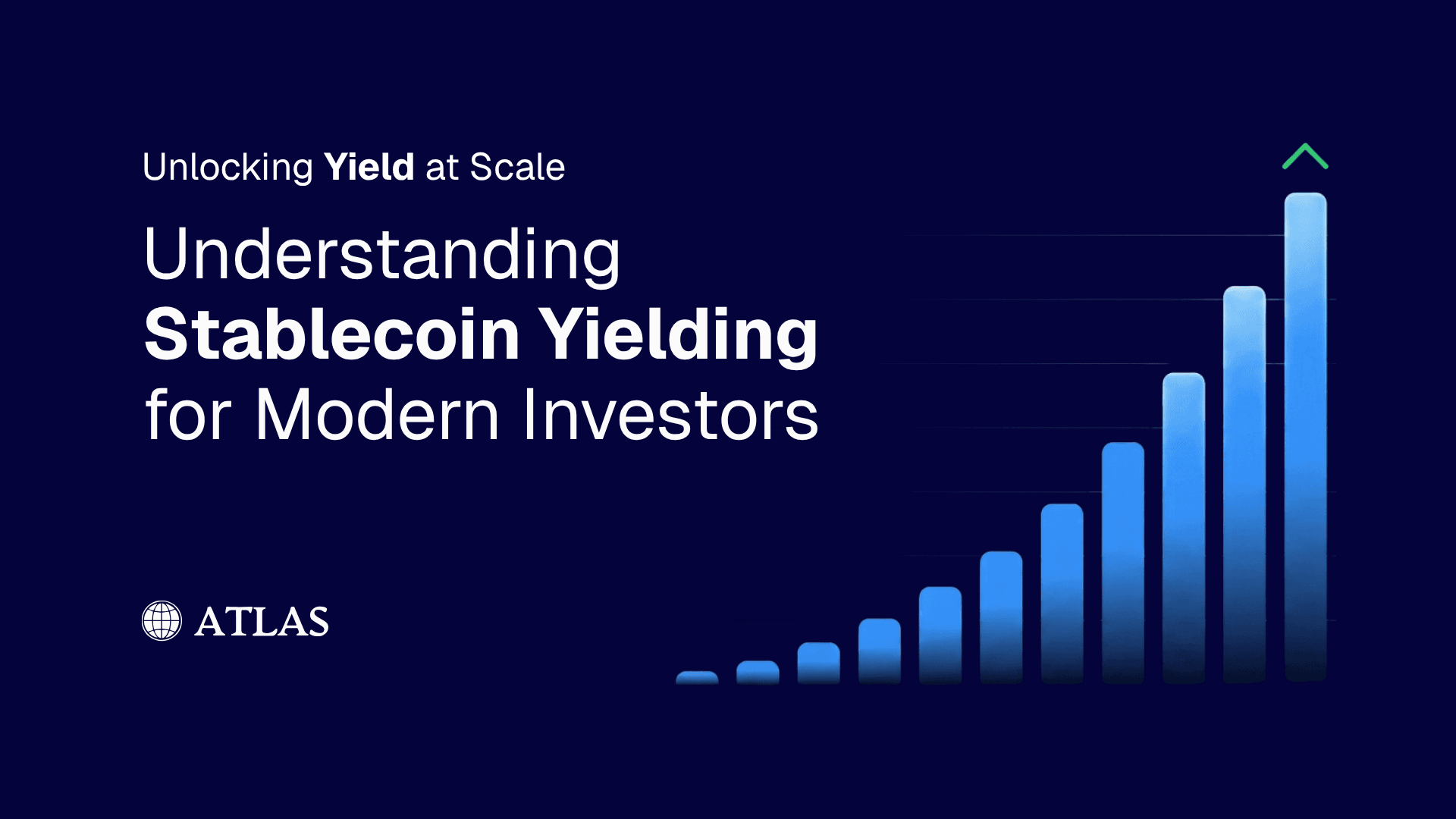
Stablecoin yielding refers to strategies where holders of stablecoins such as USDT or USDC lend their assets into credit markets in exchange for interest.
These markets operate similarly to traditional lending environments: capital providers supply liquidity, while borrowers access funds for trading strategies, liquidity provision, or operational financing.
In return, lenders receive interest payments expressed as annual percentage yield (APY).
Within decentralised finance, these credit markets are often structured through blockchain-based protocols that facilitate transparent lending pools and automated settlement.
For investors holding stablecoins as part of their portfolio or treasury allocation, stablecoin yielding can transform idle liquidity into a yield-generating asset.
Comparing Stablecoin Yield with Traditional Savings
For many investors, the natural comparison point for stablecoin yield strategies is traditional savings products.
These typically include:
- Bank deposits
- Savings accounts
- Money market funds
- Short-duration government bonds
While these instruments remain core components of traditional treasury management, stablecoin yield markets can sometimes offer competitive or higher yields, particularly during periods of elevated interest rates and active capital demand within digital asset markets.
Importantly, yield levels within stablecoin markets often move broadly in line with global interest rate cycles, as borrowing demand and credit markets respond to macroeconomic conditions.
For professional investors already active in digital asset markets, allocating a portion of stablecoin liquidity into yield strategies can therefore become part of a broader capital efficiency approach.
Liquidity and Capital Efficiency Advantages
One of the defining characteristics of stablecoin yield strategies is the operational flexibility they offer.
Unlike traditional financial markets, digital asset infrastructure operates continuously.
Stablecoin markets therefore provide several structural advantages:
24/7 market access Digital asset markets do not close. Liquidity and settlement remain available at all times.
Fast settlement Blockchain-based transfers allow capital to move quickly between venues and strategies.
Global liquidity pools Stablecoin credit markets often aggregate liquidity from participants across multiple jurisdictions.
Capital flexibility Investors can dynamically allocate stablecoins between trading, liquidity provision, or yield strategies.
For treasury teams managing digital asset exposure, these characteristics can significantly improve liquidity management and capital efficiency.
Institutional Access Challenges
Despite the opportunities, direct participation in decentralised credit markets can present operational challenges for professional investors.
These may include:
- Interacting with multiple blockchain networks
- Managing digital wallets and private keys
- Assessing smart contract risk
- Navigating protocol infrastructure
- Managing operational workflows for capital allocation
For institutional clients, these operational layers can create barriers to entry.
As a result, many professional investors prefer to access these markets through institutional-grade infrastructure providers that abstract the underlying technical complexity.
Maple Finance and Decentralised Credit Markets
One of the leading protocols enabling institutional credit markets within decentralised finance is Maple Finance.
Maple provides infrastructure for on-chain lending markets where professional borrowers can access liquidity while lenders earn yield on their capital.
Unlike many retail-focused DeFi protocols, Maple has been designed with institutional participants in mind, introducing credit underwriting structures and borrower vetting processes.
Within the broader digital asset ecosystem, Maple has become an important platform for enabling stablecoin lending opportunities backed by professional counterparties.
Atlas Integration with Maple Finance
Atlas Financial integrates with infrastructure providers and decentralised protocols to provide institutional clients with streamlined access to digital asset markets.
Through its integration with Maple Finance, Atlas enables clients to access stablecoin yield opportunities on USDT and USDC without needing to manage the underlying DeFi infrastructure themselves.
This approach allows professional investors to benefit from:
- Simplified operational access
- Institutional-grade infrastructure
- Transparent yield opportunities
- Efficient capital allocation within digital asset markets
By combining traditional financial infrastructure with digital asset protocols, Atlas helps bridge the gap between institutional capital and decentralised credit markets.
Conclusion
Stablecoins have evolved far beyond their original role as simple trading instruments.
Today, they form a core part of the liquidity infrastructure powering digital asset markets, enabling settlement, payments, and capital allocation strategies.
For professional investors and treasury managers, stablecoin yield strategies represent an emerging tool for enhancing capital efficiency, particularly when managing digital dollar liquidity.
As institutional infrastructure continues to develop, platforms that simplify access to these markets are becoming increasingly important.
Stablecoin yield opportunities, supported by protocols such as Maple Finance and delivered through institutional infrastructure, are likely to play a growing role in the evolving landscape of digital finance.
Learn More
Stablecoin yield strategies are increasingly being used by professional investors and treasury teams to improve capital efficiency while holding digital dollar liquidity. As the digital asset ecosystem matures, access to institutional-grade infrastructure for generating yield on stablecoins such as USDT and USDC is becoming an important part of modern portfolio and treasury management.
To understand how Atlas Financial enables clients to access stablecoin yield opportunities through its infrastructure and integrations with decentralised credit markets such as Maple Finance, you can explore our Yielding solutions.
Explore Atlas Yielding & Staking solutions: https://atlas.financial/yield-generation
You can also take a closer look at the Atlas platform through our interactive product demo, which provides an overview of our Banking & Custody, On and Off Ramping, Yielding, and Staking capabilities.
View the interactive demo or speak with our team: https://atlas.financial/?modal=interactive-demo